
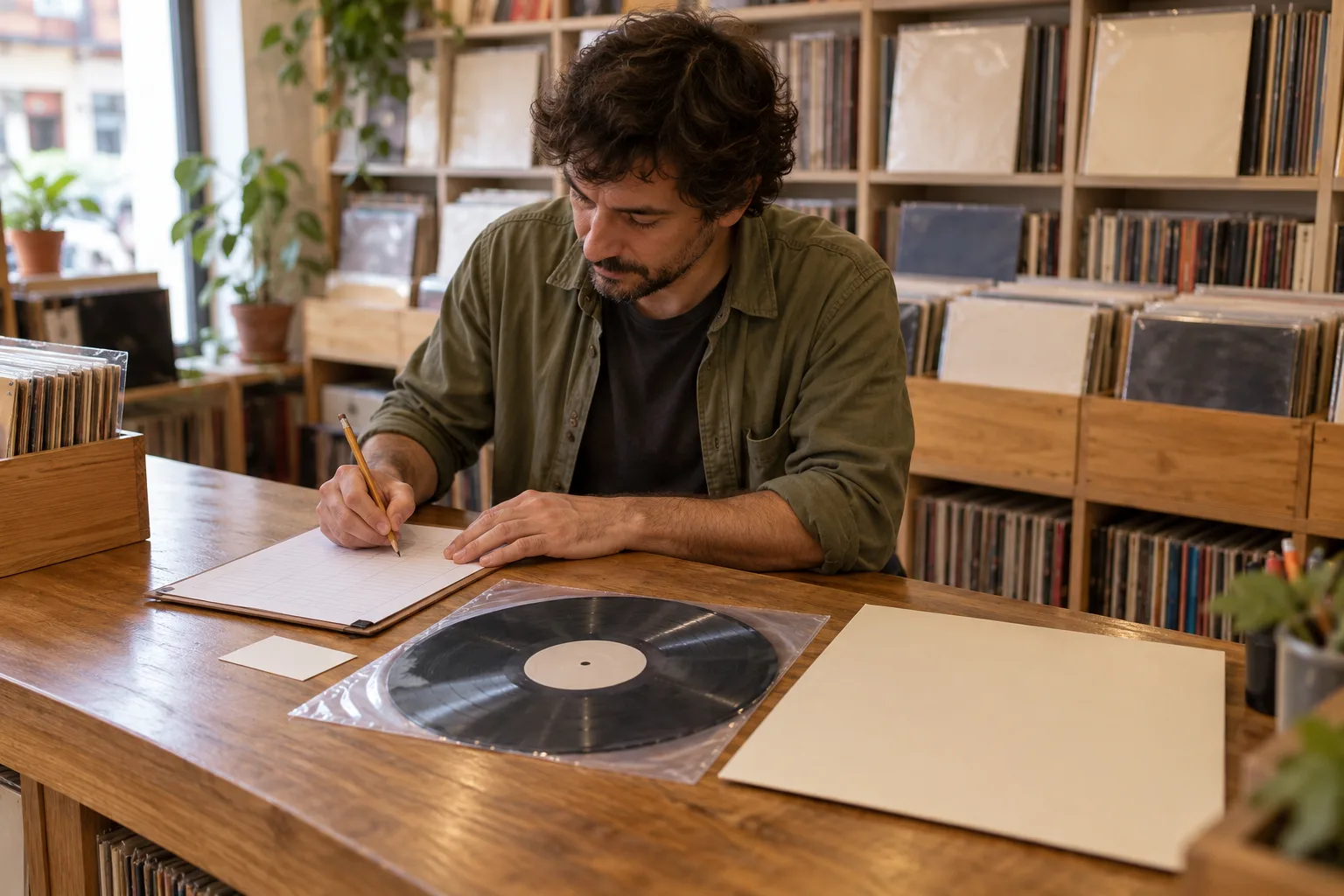
The sleeve looks right. The edition is still unconfirmed.
A used record arrives, the title matches a catalogue entry, and one mark on side B remains unreadable. Do you already know which edition you will list? In this guide’s fictional case, two candidates share the legible information. The useful response is to keep both unconfirmed and request that reading; choosing the first would invent an identification.
We propose an AI trial for preparing an internal shop record: compare transcriptions, flag gaps and draft notes for review. Below are the inputs, a manual reference and an instruction to try. The person holding the copy decides its identification and condition; the assistant does not authenticate pressings, listen to records or set prices.
Three blocks before writing a sales listing
Discogs guideline 5.2.o asks contributors to transcribe runout inscriptions separately for each side and retain unidentified parts as such. The runout is the area near the label containing these markings. Guideline 1.4 explains that a matrix difference does not necessarily mean a separate release: it can be a manufacturing variation. Do not turn one different letter into an automatic conclusion.
For condition, Discogs uses the Goldmine scale and describes aspects of the vinyl and sleeve. This does not allow a grade to be assigned from an album title. In this trial, leave grading to the shop’s examination of the copy; descriptive notes and the documented playback check, if any, must not be replaced by a generated label.
- Physical copy: unique stock identifier, stated format and disc count, references to notes and authorised photographs. Two copies of the same album retain individual records.
- Identification: catalogue number as read, where it was read, inscriptions for each side and candidates with sources. Separate information copied from the object from an external entry’s claims.
- Condition: observations about the record, observations about the sleeve, scope of any documented playback check and grades decided by the human reviewer. “No playback check recorded” does not mean “plays perfectly”.
Exercise: the mark you must not fill in
All codes and records below are invented; they do not identify a commercial record or a real Discogs search. E is a human intake note: “Copy V-01; one disc; catalogue CT-07 on spine and labels; side A: CT 07 A1; side B: CT 07 B [unreadable mark]; sleeve: spine rubbing; disc: examination pending; no playback check recorded.”
F1 and F2 are fictional comparison entries containing only these fields: both state one disc and catalogue CT-07; F1 says A: CT 07 A1, B: CT 07 B1; F2 says A: CT 07 A1, B: CT 07 B2. They provide no year, country, photographs or valuation. The table is our authored manual reference, not a measured model response.
| Field | Documented comparison | Still outstanding |
|---|---|---|
| Catalogue and quantity | E, F1 and F2: CT-07 and one disc. | Partial field agreement; no edition identified. |
| Side A | E, F1 and F2: CT 07 A1. | This reading cannot distinguish F1 from F2. |
| Side B | E retains [unreadable mark]; F1 ends B1 and F2 B2. | Do not fill in 1 or 2. Both candidates remain unconfirmed. |
| Sleeve and record | E notes sleeve spine rubbing; the record has not been assessed. | Do not transfer rubbing to the vinyl or invent VG, VG+ or NM grades. |
| Playback, date and price | E records no playback check; the entries provide no date or price. | Do not claim noise-free playback, first pressing, year, country or value. |
An internal draft that preserves the questions
First attach the intake note to copy V-01. Then request a comparison of equivalent fields and check each row against the original. Record a literal difference as a difference, not automatic proof of a new edition. Where information is missing, prepare a specific question for the person able to inspect the object.
For this exercise our proposed draft is: “V-01: internal record awaiting identification. Catalogue CT-07 and side A reading match F1 and F2; side B mark remains unresolved. Sleeve spine rubbing according to intake; disc condition awaiting assessment; no playback check recorded. Awaiting human reading of B and examination of the copy before drafting the final listing.” This is not a published listing or an approved sales description.
If a new human note says “B: CT 07 B2, supersedes the incomplete reading”, retain the earlier note and record that this field agrees with F2 and differs from F1. The rest of the identification still needs checking; this change alone proves neither edition, authenticity nor condition. Another copy with the same catalogue number must not inherit V-01’s observations.
A prompt to try without customer data
Paste only the exercise’s E, F1 and F2 into an authorised text assistant. Seller names, purchase histories and photographs of people are unnecessary. Before using real documents, check permissions and processing, access and retention conditions; restrict the material to what the task needs.
- Proposed instruction: “Prepare an internal record for V-01 by comparing E with F1 and F2. Return field, literal value from E, candidate values, source and outstanding question. Keep sides A and B separate and retain [unreadable mark]. Do not complete characters or choose a candidate by resemblance. Separate record and sleeve observations; preserve the scope of any recorded playback check. Do not assign grade, authenticity, edition, year, country or price; do not write an approved listing. Finish with an internal draft and outstanding human checks.”
- Check the response against the table: choosing F1 because it comes first, guessing B2, calling the vinyl NM or turning sleeve rubbing into a record defect would be errors. Claiming a database was searched also fails: in this trial the assistant only receives the pasted fictional records.
- The instruction states desired behaviour, not demonstrated capability. If the assistant adds information from memory, remove it from the draft and record the failure; do not seek convincing wording for an identification that still lacks evidence.
An intake pilot, not an automated valuation
Prepare a small set of fictional cases with a manual reference: the unreadable mark, a corrected reading, two copies with the same catalogue number and a playback note covering only one side. Agree the fields to check and who can approve progression to a listing. Keep the trial separate from published inventory.
Count characters completed without a source, unsupported candidate choices, observations mixed between record and sleeve, and claims about unplayed audio. Compare total preparation-and-review time for each record with doing it manually. The pilot has not been run: these are proposed measures, with no results or savings promise. If reviewing means rewriting everything or inventions persist, retain the manual process and correct the trial before connecting it.
When to consider a custom integration
A manual trial means pasting the invented records and reviewing the response. Connecting intake to inventory or a selling platform requires a separate assessment: available fields and permissions, terms of use, identifiers for each copy, change history and human approval. A connection to Discogs or your shop software is not assumed to exist.
Adaris can assess custom software, CRM or AI automation case by case. An initial scope could prepare internal records with sources and questions, without automatically publishing listings or changing prices. If a reviewed spreadsheet is enough, start there. Commercial decisions and physical assessment remain with the shop; Adaris handles commercial enquiries in Spanish.
Related services
Sources
Do intake notes mix edition and copy condition?
Tell us how you receive and check records. We can assess a custom scope; commercial enquiries in Spanish.