
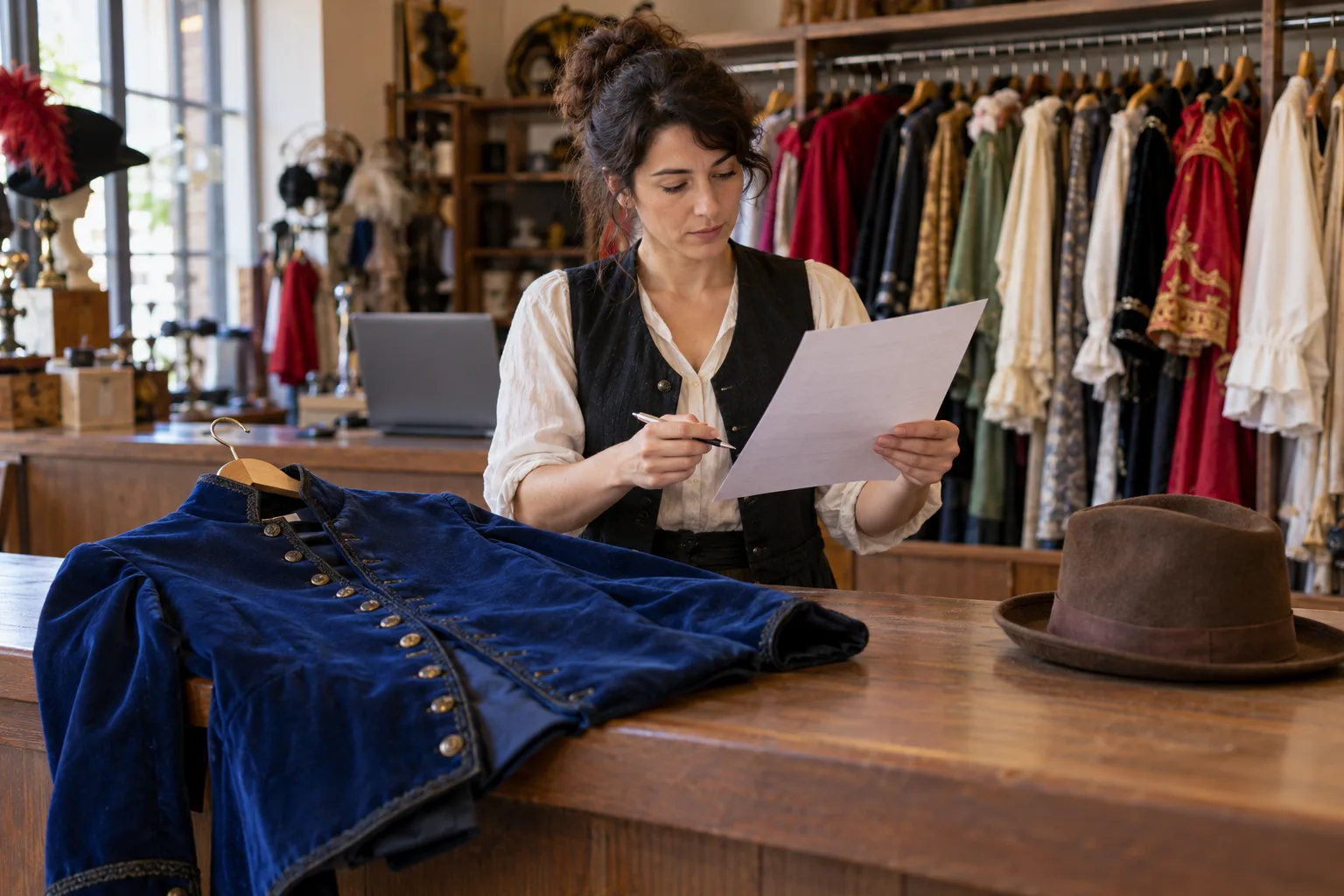
A bag on the counter does not confirm a complete costume
The jacket comes back and a hat appears. The person says everything is in the bag, but the belt received has no reference. Before marking the costume returned, each piece needs checking against the dispatch list. This guide proposes trialling AI to draft that comparison while retaining unresolved identities and pending preparation.
You will find an invented case, a manual reference and a trial prompt. The exercise has not been run: we present neither assistant results nor a real rental. The aim is to review a partial return without automatically declaring losses, releasing garments or deciding charges.
Separate the commercial outfit from its physical pieces
I propose using two identifiers: one for the outfit and one for each component dispatched. A description such as “period costume” helps recognise the order, but in this exercise it does not replace the jacket, hat and belt list. If a separate cape also went out, retain its own line even if it comes back in the same bag.
Stock Point’s garment-rental page describes individual-unit control, partial returns and cleaning or repair tracking. AbracadabraNYC’s rental FAQ explains that it keeps its costume pieces together and cleans each returned piece before putting it back on the rack. These are practices and features described by those businesses, not universal rules, buying advice or tools we have tested.
For this exercise, distinguish documented receipt, correspondence with a dispatched piece and preparation approved by staff. A piece can be received without being ready. Being prepared does not confirm availability for a future date either: actual bookings and conditions would need checking.
The fictional file: four known pieces and an unidentified belt
All codes, documents, messages and rules below are invented. Use only these data; do not submit real customer information, contracts, photographs or conversations without permission and suitable confidentiality and processing conditions.
D0 · Internal trial rule: “Prepare a proposal for review. Do not change inventory, availability, bookings or deposits. Only staff may identify an uncoded piece and approve its preparation after the appropriate checks.”
D1 · Dispatch R42: “Outfit K1: jacket J17, hat H3 and belt B8. In addition, cape C5 as a separate item outside K1.” D2 · Receipt: “J17, H3 and C5 received with their labels. An uncoded belt is also received; it is kept separately as object U1, not assigned to an order. Preparation of J17, H3 and C5 is pending.”
D3 · Message from the person returning R42: “I left everything in the bag.” It gives no codes and does not identify U1. Retain it as an account, without turning it into a staff check. No note confirms that U1 is B8.
Manual reference: do not close K1 by counting three objects
This table is the editor’s reference for checking a future response, not generated output or real inventory. It proposes neither a charge nor a refund.
| Dispatched piece or received object | What is documented | What remains pending |
|---|---|---|
| J17 · jacket in K1 | D1 includes it; D2 confirms labelled receipt. | Preparation pending under D2; no documented release. |
| H3 · hat in K1 | D1 includes it; D2 confirms labelled receipt. | Preparation pending under D2; no documented release. |
| B8 · belt in K1 | D1 includes it; D2 does not confirm receipt under that identity. | Return reconciliation unresolved. D3 does not identify the belt; do not declare a loss. |
| C5 · separate cape, outside K1 | D1 separates it from the outfit; D2 confirms labelled receipt. | Preparation pending. Do not use it to complete K1. |
| U1 · uncoded belt received | D2 confirms the physical object, without an assigned order. | Staff identification needed; do not link it to B8 by resemblance, count or message D3. |
Trial this prompt with D0–D3 in full
“Prepare a comparison for human review of R42. Preserve the codes and K1 composition from D1. Give each dispatched piece a row, and object U1 a separate unassigned row. Include the source and exact quotation for receipt, correspondence and preparation. Write pending when undocumented; distinguish unconfirmed receipt from loss. Retain D3 as an unverified statement. Do not complete K1 with C5 or U1. Do not invent identities, inspections, cleaning, availability or deposit decisions. Also return the specific questions staff need to resolve. Execute no changes.”
Claude’s documentation recommends allowing the model to acknowledge uncertainty and checking claims through citations. That guidance inspires the prompt; it does not guarantee an assistant will respect the comparison. We have not tested a rental application or an inventory connection here.
Check the five rows first. Then check membership, quotations and states separately. Reject an answer that says “everything returned” because of D3, turns U1 into B8, includes C5 in K1 or declares J17 ready merely because it was received. Physical inspection, identification and any commercial decision remain staff responsibilities.
Clarify receipt without marking the whole outfit prepared
Run a separate second exercise adding D4 · Staff note: “U1 is identified as B8 from R42 and its receipt is linked. H3 has been checked, prepared and approved to return to the collection. J17 and B8 still await preparation. C5 remains pending.” This is another fictional document, not an actual check.
The reference changes: D4 resolves B8’s receipt, while retaining that D2 recorded an unassigned U1. Do not count U1 and B8 as two different belts after identification. H3 has preparation approval; J17 and B8 do not. K1 now has its components received but is not fully prepared. C5 remains outside K1 and pending. Future availability has not been checked and no deposit decision has been made.
This variant checks two different failures: keeping a question open after a new source resolves it, and extending one piece’s approval to an entire outfit. Save both responses and compare each with its corresponding reference.
A pilot that measures checking too
Before connecting anything, prepare more fictional cases: an accessory with no reference, an incomplete outfit, a separate item in the same bag, a repeated receipt and partial preparation approval. Write the manual reference before requesting a response. These are proposed cases, not incidents observed at a business.
Record invented associations, omitted or double-counted pieces, states changed without a source and questions still unresolved. Define invalidating errors in advance; releasing a piece without approval would be one. Compare data preparation, checking and correction time with doing the task manually. This guide demonstrates no savings or accuracy results.
When existing management is enough and when to assess integration
If your application already supports outfits, piece codes, partial receipt and preparation, start by reviewing how those features are used. AI does not replace identifiable inventory. A manual trial means copying fictional documents into an assistant and checking a proposal; it does not modify your application.
A possible integration would require investigating the exports or connections actually available, permissions, receipt history and who may resolve identities or approve preparation. Separate an AI proposal from an approved inventory movement, avoid recording the same receipt twice and retain a way to recover from errors. We claim no compatibility with any application mentioned.
Adaris develops custom software, CRM systems and AI automation case by case. We can assess a dispatch-and-return comparison screen with human approval and agreed acceptance criteria. This is a development proposal, not an existing proprietary costume-rental product. Commercial support is in Spanish.
Related services
Sources
Does a return close before every piece is checked?
Tell us how you record outfits, accessories and preparation. We can assess a comparison step with human approval for your workflow. Commercial support is in Spanish.