
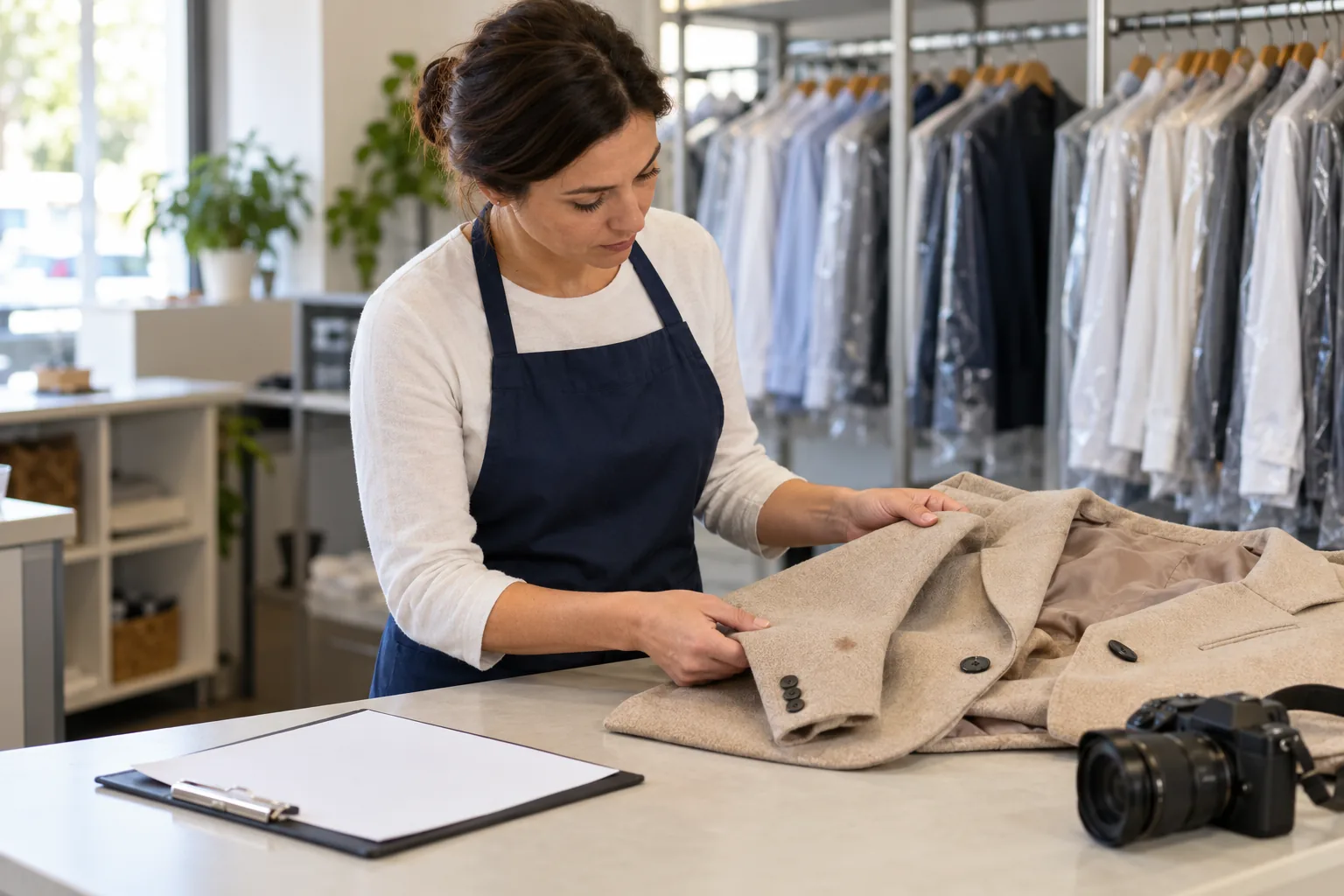
“I think it was coffee” does not identify the stain
A jacket arrives at the counter. In this entirely fictional case, the person bringing it says: “I think I spilled coffee on it; I also tried cleaning it at home, but I cannot remember what I used.” The receiving professional notes a brown mark on the right cuff. These are three different things: a suspected cause reported by the customer, a reported cleaning attempt and a professional observation. AI must not turn them into “coffee stain treated with stain remover”.
You can trial a text assistant to organise these notes into a record awaiting review. The useful questions are what is recorded, who said it and what still needs checking. Identifying a stain, choosing treatment or assuring removal remains outside this exercise. The record accompanies garment inspection; it does not replace it.
Before the assistant: an item reference and the source of every note
A jacket and trousers may arrive under one order. For the pilot, give each piece a fictional reference and keep every original note. Do not automatically apply an observation about one piece to the entire outfit. If a note says only “sleeve”, leave which sleeve unresolved instead of guessing right or left.
Tintorerías Tarma describes intake inspection and transferring observations to the collection ticket and garment identifier. That practice provides context for this administrative proposal. We are designing an internal exercise, not a legally compliant receipt template or treatment guidance.
- Order and item reference; description written by a person, without inferring fibre composition or brand.
- Intake observation: specific area, neutral description, author and inspection time.
- Customer comment: retain wording such as “I think”, “I cannot remember” and “perhaps”. This is not technical confirmation.
- Photographs where appropriate: references to authorised originals linked to the item and time, without claiming they establish cause or liability.
- Open checks: label inspection, area clarification, service assessment or date confirmation. An empty field does not mean “no issues”.
Try these invented notes without uploading photographs
Fictional order T-026, item P1: beige jacket; item P2: dark trousers. N1, intake, P1: “Brown mark on right cuff”. N2, customer, P1: “I think it is coffee; I tried cleaning it at home, I cannot remember what I used.” N3, intake, P1: “Care label not yet inspected”. N4, intake, P2: “Loose waistband button”. N5, customer, order: “By Friday if possible”. No composition, treatment, price or delivery date has been accepted.
The following table is an editorial interpretation of the example, not an observed assistant response or demonstrated result. Use it as a reference when reviewing your trial output.
| Item and note | What may be recorded | What must not be filled in |
|---|---|---|
| P1 · N1 | Intake observes brown mark on right cuff | Cause of mark or suitable treatment |
| P1 · N2 | Customer suspects coffee and reports cleaning with an unknown product | Confirmed coffee, a named product or absence of risk |
| P1 · N3 | Care label awaiting professional inspection | Fibre, care symbols or suitability for a process |
| P2 · N4 | Intake observes loose waistband button | That it is broken, missing or authorised for repair |
| Order · N5 | Customer requests Friday if possible | Delivery commitment or accepted service |
The prompt: organise notes without filling in the story
“Use only these fictional dry-cleaning intake notes: [paste N1–N5 and references T-026, P1 and P2 from the example]. Draft an internal record. For each detail show item, source note, intake observation or customer comment, original wording and pending check. Preserve uncertainty and the unknown product. Do not identify stains, fibres or care symbols; do not propose cleaning, repair, prices, dates or acceptance. Write pending when information is missing. You have not seen garments or photographs. Do not turn a request into a commitment or ‘not recorded’ into ‘no defect’. Finish with questions for the person reviewing intake.”
Check the draft against the notes line by line. Questions here include which product was used, what the label actually says when inspected and whether Friday can be confirmed after assessment. If the customer cannot remember a detail, it must remain unknown. Asking does not guarantee an answer.
Anthropic’s Claude documentation describes the risk of incorrect or context-inconsistent responses and suggests restricting answers to supplied documents and checking claims against references. We adapt these precautions for the exercise; they do not establish that this prompt works correctly or remove the need for review.
A photograph does not fill the gaps
This pilot uses invented text. If image use is later agreed, a garment photograph may accompany the record, but this proposal does not ask AI to interpret it. Keep the original and its relationship to the item and observation; a summary must not overwrite it.
Do not infer fibre, cause, age of a mark, fabric resistance or cleaning outcome from colour, a photograph or a customer note. The label, condition and service need professional assessment. Nor should “loose button” become authorised repair. Technical decisions and any acceptance must follow the business’s usual process.
Can your current software handle this, or is there a connection to assess?
First check whether you can already record observations and attach images to individual garments. Lavanda Software advertises intake receipts and webcam photographs. This is a feature that provider describes, not verified compatibility with your equipment, software or Adaris. Clearly defined fields may suffice if the problem is that the source of observations is not recorded.
In a manual trial, you copy fictional notes, request a draft and review it. Connecting the counter to an application adds a different scope: data access, matching notes to items, permissions, change history and error recovery. AI might propose the summary; identification rules and confirmation by the responsible person must remain in the system.
Adaris can assess scoped custom development or integration for that step: collect authorised notes from one source and show a draft beside the original for validation. Fields, responsibilities, export, access and acceptance criteria would be agreed after feasibility checks. This is a case-by-case service proposal, not an existing proprietary dry-cleaning product. It excludes treatment decisions, sending notifications and automatic order changes.
Measure the errors a tidy record can conceal
Prepare fictional cases and write the reference answers before testing: a mark with unknown cause, two pieces with different notes, an uninspected label and an unconfirmed delivery request. Include a case with no observations recorded: the assistant must not conclude the garment is in perfect condition.
Compare arranging the notes manually with reviewing the assistant draft. Count omitted details, invented causes or materials, notes assigned to the wrong piece, uncertainty changed into certainty and added commitments. Also record total review time and corrections. These are proposed pilot metrics; no outcomes, savings or accuracy are presented.
If an output invents a treatment or declares a service accepted, do not use it to advance the order. Correct the draft and review the procedure before expanding the trial. Then decide whether to retain a manual record, configure existing software or assess one specific connection.
Start with fiction and keep the business record
Do not paste real names, telephone numbers, receipts or photographs into an assistant without authorisation and appropriate terms. T-026 and the invented notes are sufficient for a trial. Acelera pyme recommends checking terms of use and generated content; a conversation history is not the dry cleaner’s archive.
Before any integration involving real data, establish what is needed, who can see it, retention and how to retrieve the original. Keep the proposed administrative record separate from professional assessment. The first pilot should test whether intake information and its uncertainties can be preserved faithfully, rather than delegate decisions about the garment.
Related services
Sources
Do intake notes reach the workshop incomplete?
Tell us in Spanish how you record each garment and where observations are lost. Using a fictional example, we can assess custom development or integration for that step, with agreed scope and checks. Commercial communication is in Spanish.