
“It belonged to my grandmother” does not identify the finish
A customer describes a chest of drawers as “nineteenth-century walnut with its original varnish”. The record becomes: “Walnut chest, nineteenth century, original finish; strip it”. Three attributions have become certainties and an intervention nobody agreed has appeared. The first correction is to preserve who said what and leave identification pending.
This guide proposes trying AI to review documentation before furniture restoration: organise accounts, observations and documents without authenticating the piece or choosing treatments. It includes a fictional case, a manual reference and a prompt. This is a proposed trial, not a completed test of accuracy or savings.
Before quoting: photographs, a visit and professional judgement
On the pages consulted on 24 October 2026, Retro-Chic offers a quotation from a photograph; Kromatics describes visiting and measuring before producing an itemised quotation. These are those workshops’ published approaches, not common rules or evidence that a photograph can identify a finish.
The Canadian Conservation Institute explains that original finishes have historical, aesthetic and financial value. Identification deserves a separate question: a dark colour or family story should not automatically become “original varnish” in your record. Conservation judgement and any intervention belong to the professional.
As an example of real research, a study published by the Canadian Association for Conservation examined varnish samples from nineteenth-century Canadian furniture using instrumental techniques. Its scope is the set studied: it does not authenticate our fictional chest or establish the composition of every similar piece. This guide gives no tests, products or restoration procedures.
A record that preserves provenance instead of mixing everything
Prepare one record per piece with five separate blocks: customer account; professional observation; supplied document and its scope; identification pending; and requested or authorised intervention. Preserve photo codes and locations, record date, note author and an exact quotation where meaning matters. Do not turn “appears to be” into “has been identified”.
This trial uses descriptions written by a person. It does not ask the assistant to identify wood, age, deterioration or substances in images. Photographs act as documentary references; the professional decides what needs examination and how to examine it. A mark in a photograph does not by itself establish its cause.
Start with fictional data. Do not upload photographs of homes, documents, conversations or customer data without permission and appropriate processing arrangements. Keep originals and responses separately. Do not turn the record into a valuation, authenticity certificate or work instruction.
TEST-CHEST: the error is a change in certainty
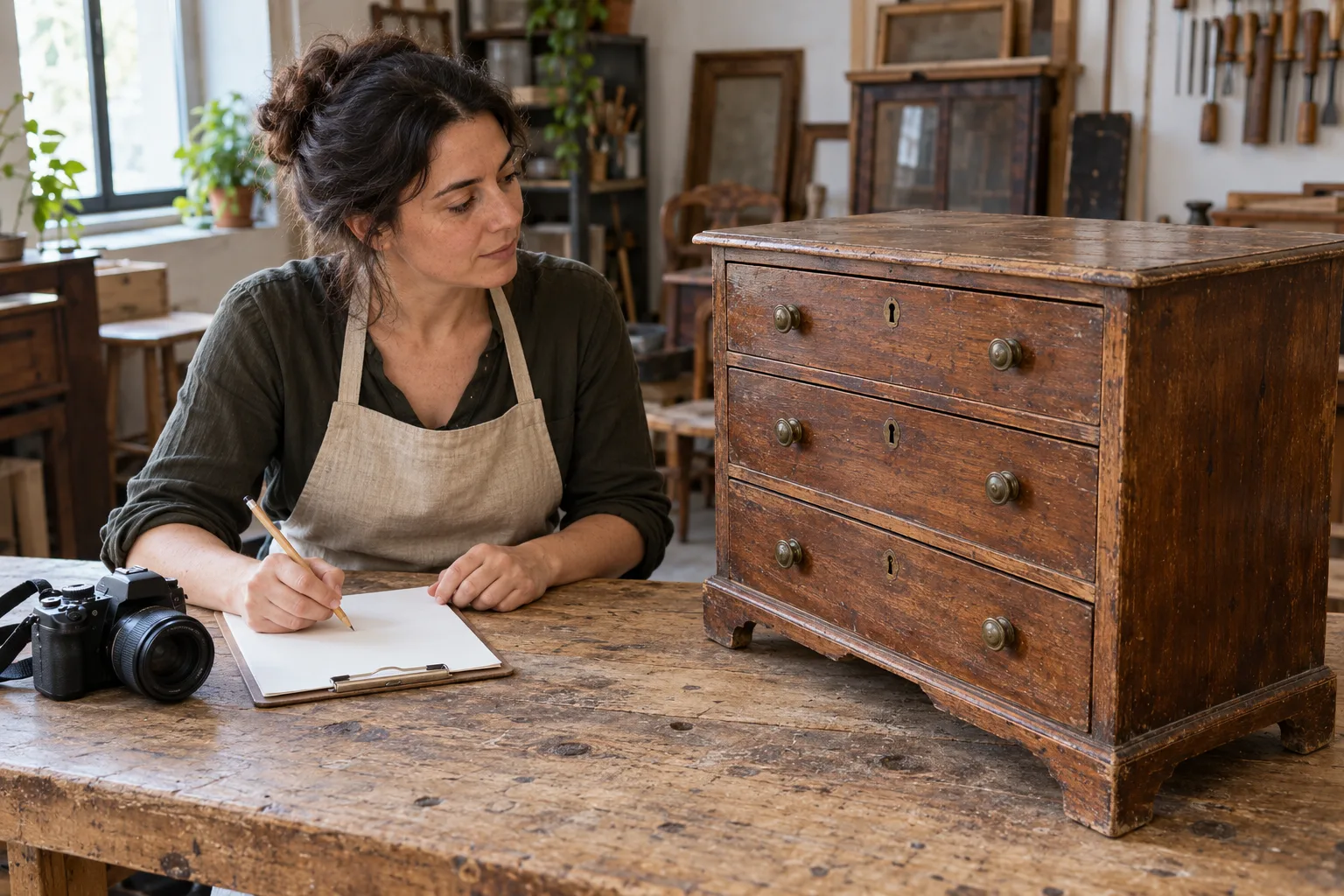
All texts, codes and people in this exercise are invented by the editor. The observations are fictional notes, not a real examination of the cover image. There is no customer, verified age or obtained AI result.
C1 · Customer account: “It belonged to my grandmother; the family always said it was nineteenth-century walnut. I think it still has the varnish from then. I want to keep the dark appearance and have the options explained before anything is done.” No invoice, report or other documentation is supplied.
O1 · Fictional restorer’s note: “Piece M-01, chest of drawers. Photo F01: general view. Photo F02: detail of a lighter area on the front edge of the top. A colour difference is recorded; its cause, the wood, period and finish have not been identified. Professional examination pending.”
B1 · Draft to review: “M-01: nineteenth-century walnut chest, original varnish worn in F02. Customer authorises stripping and a light wood appearance.” C1 and O1 are the only inputs in the first test.
The manual reference preserves the story without certifying it
The following table is written by hand for comparison with a later response. It is neither AI output nor a diagnosis.
| Field | Manual reference | Correction to B1 |
|---|---|---|
| Wood and period | Family attribution in C1: nineteenth-century walnut; unverified | Do not present these as the restorer’s identification |
| Finish | C1 thinks it is original; O1 does not identify it | Remove original as a confirmed fact |
| F02 | O1 records a lighter area with unknown cause | Do not call it worn varnish or diagnose deterioration |
| Request | Keep the dark appearance and hear options before action | Remove authorisation to strip and expose light wood |
| Next step | Ask about earlier documents and prepare professional examination | Do not fill gaps with treatments, price or deadline |
A prompt for reviewing the record with checkable quotations
Paste the complete fictional texts C1, O1 and B1 after this instruction. Check every quotation against its original input: text inside quotation marks can also be fabricated.
“Compare B1 against C1 and O1 for piece M-01. Return a table with the B1 assertion, source document and exact passage, information type (account, observation or document), what is supported, any unjustified change in certainty and the outstanding question. Preserve I think and pending where applicable. Do not identify wood, age, cause, composition or originality. Do not infer authorisation from an aesthetic preference. Do not suggest treatment, valuation, price or deadline; send nothing and confirm no work. Where support is absent, say not recorded and retain the detail as an attribution where appropriate.”
A clarification written by hand would be: “You tell us your family attributes it to nineteenth-century walnut and you want to keep its dark appearance. Do you have documentation or information about previous interventions? Identification and options remain pending professional examination.” This is a draft for review, not a sent message.
Variant: a new report does not prove everything is original
Add R2 · Fictional professional report: “M-01. A shellac coating is identified in the examined area of the top. This note does not determine application date, originality or the finish in other areas. No treatment has been authorised.” This document is invented for the exercise; no analysis has been performed and it does not teach a testing method.
The manual reference can now add “R2 identifies shellac in the examined area of the top”, preserving attribution and limits. It still cannot say “the entire chest retains original nineteenth-century shellac”. Nor does it change the wood, period or authorisation. Keep C1 as the customer’s account alongside the new professional information.
Anthropic recommends allowing an assistant to admit uncertainty and checking assertions through quotations. This informs the review design but does not demonstrate that this prompt works. In particular, check whether the response turns R2’s local scope into a conclusion about the whole piece.
A measurable pilot before connecting the paperwork
Prepare several fictional records: an account without documents, described photographs, a report with limited scope and a later customer correction. Write the manual reference first. Then compare attributions promoted to facts, invented causes, omitted report limits, preferences converted into authorisation and quotations that do not match.
Also record preparation and review time, corrections and who approves them. Decide beforehand what prevents use of an output; for example, an intervention presented as authorised with no supporting document. If the assistant adds work or confusion, adjust the fields and instruction or keep manual review. There are no measured pilot results.
From a manual assistant to a custom case record
Trying this prompt means copying fictional texts into an assistant and reviewing its proposal. It does not connect a photo folder, email or workshop software. A clearly separated record may be enough to resolve the confusion.
If several people receive pieces and update reports, a custom record could be assessed: piece identity, original photos, note versions, provenance of each assertion and separate approvals. Formats, permissions, preservation of originals, data arrangements and actual system access would need checking first. Compatibility with restoration software is not assumed.
Adaris Tech develops custom software, CRM and AI automation case by case. To discuss this workflow, prepare a fictional record and explain where accounts, observations and reports become mixed. Scope and quotation are agreed before engagement; commercial communication is in Spanish.
Related services
Sources
Do accounts and reports get mixed in your records?
Tell us in Spanish how you document pieces and review proposals. We can assess a custom record with a defined scope.