
Before adding allowance, check what that piece includes
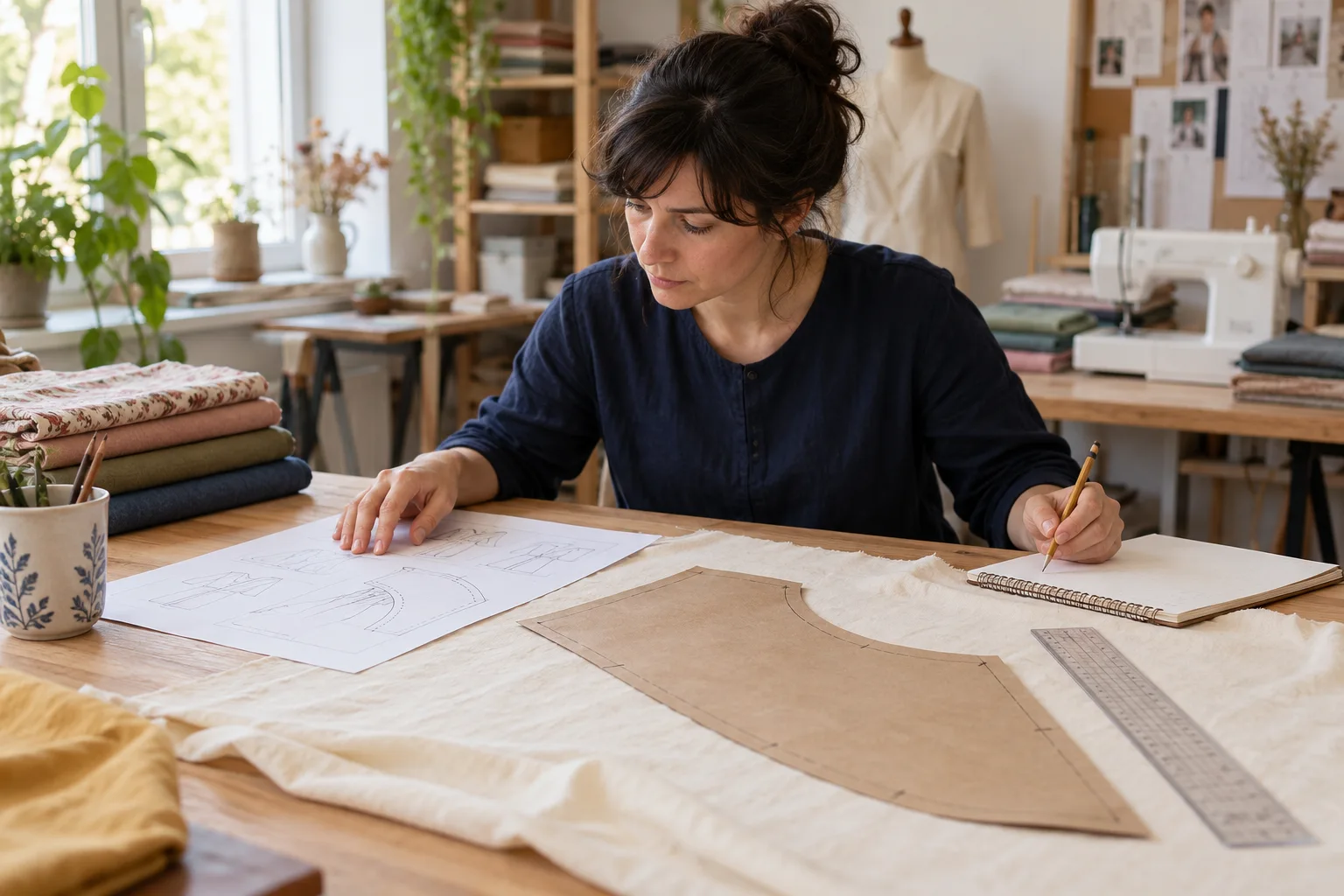
On the table are a pattern, its instructions and a preparation sheet for the studio. The sheet says “add 15 mm”. But does that piece already include the allowance? This guide proposes trialling a text assistant to compare instructions by piece and edge, preserve exceptions and prepare questions for the person reviewing the pattern.
The first check is documentary: identify the job’s file and version, find whether allowance is included and link each exception to its edge. An AI table does not validate drafting, size or fit. Here is a fictional case reviewed manually and an instruction for trialling the comparison before considering an integration.
The publisher gives context; the specific instructions decide
Burda’s FAQ explains that most of its patterns exclude allowances, but some models include them. In its Zadie tutorial, Tilly and the Buttons describes included 15 mm allowances and allows different instructions at individual steps. These are their authors’ published contexts, not a rule to transfer to every pattern.
Mercería Botton likewise directs readers to the instructions when checking allowances. That is the opportunity for this trial: review the job’s text without substituting studio habits for it. We have not tested a patternmaking application or measured search demand or other businesses’ results.
A studio exercise: included does not mean add
The entire case is invented and cannot be used to manufacture a garment. It is not taken from a commercial pattern, contains no person’s measurements and includes no geometry. R1 is the designated instruction for piece A in this exercise: “Piece A: 15 mm seam allowances included; neckline 10 mm and hem 30 mm, also included.” R2 says: “Piece B: allowances not included; width pending definition.”
The preparation sheet contains the notes in the second column. The third column is our manual reference for reviewing the exercise; it is not a model response or evidence of an executed trial.
| Piece and edge | Note on fictional preparation sheet | What to review against R1 or R2 |
|---|---|---|
| A · side seam | Add 15 mm | R1 states 15 mm included: flag that the sheet requests adding allowance already included. |
| A · neckline | Included allowance 15 mm | R1 states 10 mm included for this edge: flag discrepancy without changing the pattern. |
| A · hem | 30 mm; adding pending | R1 states 30 mm included: clarify the adding note without treating the hem as a 15 mm seam. |
| B · cuff | Add as for A | R2 excludes allowances but leaves their width pending: request a definition for B; do not copy A’s 15 mm. |
Uncertainty must stay open even when a number appears
Add another fictional input: loose note R3 says “A neckline: 7 mm”, without a version or confirmed link to the job. The list must preserve R1 and R3 and ask the responsible person which version R3 belongs to. Choosing 7 because it is smaller is insufficient, as is assuming it is a more recent correction.
In the exercise, R1 remains the designated instruction; R3 is a documentary conflict needing clarification before proceeding with that edge. The assistant can prepare the question but cannot decide what the patternmaker meant. It must not turn a direction to trim allowance after sewing into the pattern’s initial allowance either: record the operation and its stage if present in the source.
Prepare the inputs and request a review, not a new pattern
Copy only the fictional texts above into an authorised assistant. For a real job, first review pattern-use permissions, processing terms, access and retention; avoid uploading personal measurements or client designs for this trial. Identify each document’s version and transcribe the piece and edge labels checked by the professional. Do not ask the model to guess a photograph’s scale.
- Proposed instruction: “Compare R1, R2, R3 and the preparation sheet by piece and edge. Return source and version, exact quotation, stated allowance, whether included, local exception, discrepancy and outstanding question. Apply each rule only within its explicit scope. Preserve mm and the stage of the operation. Flag missing widths and unversioned notes; do not fill gaps from the publisher, another piece or convention. Do not turn included into add. Do not draft, calculate new lines, edit files or approve cutting. Keep conflicts separate.”
- Compare the output with the four rows and R3’s unresolved issue. A response assigning 15 mm to cuff B or resolving the neckline from the 7 mm note needs correction. The prompt states what you want the model to do; it does not guarantee compliance.
- Anthropic recommends allowing the assistant to acknowledge uncertainty and grounding review in sources. That supports requesting quotations and open questions, not promising a correct comparison. In this trial, the studio professional checks every row against the original instruction.
Test missing information as well as the complete example
Remove “included” and the final clarification from R1. The exercise no longer establishes that those allowances are built in: the response must distinguish stated width from unconfirmed inclusion. It must not retain its previous conclusion from memory. In another variant, supply only R2: B’s width remains pending even if the assistant knows sewing conventions.
Prepare a small fictional set with clear exceptions, unversioned notes and sheets without discrepancies. Save the manual reference before using AI. Count missed exceptions, invented values, confused inclusion and conflicts marked resolved. Measure full preparation, review and correction time against manual comparison. There are no results or demonstrated savings.
Agree what prevents proceeding: for example, inventing a width or removing an exception sends that proposal back for review. Even if every text matches, the professional still checks piece correspondence, version, drafting and pattern suitability before working on fabric.
From copying instructions to connecting the studio process
Start with manual review using the example. If the trial proves useful, integration would require linking job, document, version, piece, edge and decision, with permissions, history and recovery. It would need to distinguish a review proposal from an authorised preparation sheet. Connection to your patternmaking program or file manager must be assessed case by case; we claim compatibility with none.
Adaris can assess custom software, CRM or AI automation for that limited process. A proposal could gather discrepancies and record the responsible person’s response if the tools and data allow it. We are not presenting a proprietary patternmaking SaaS or a system that generates or approves patterns. Commercial support is in Spanish.
Related services
Sources
Do the instructions and studio sheet end up telling different stories?
Tell us how you link jobs, patterns and reviews. We can assess a limited custom development; commercial support is in Spanish.