
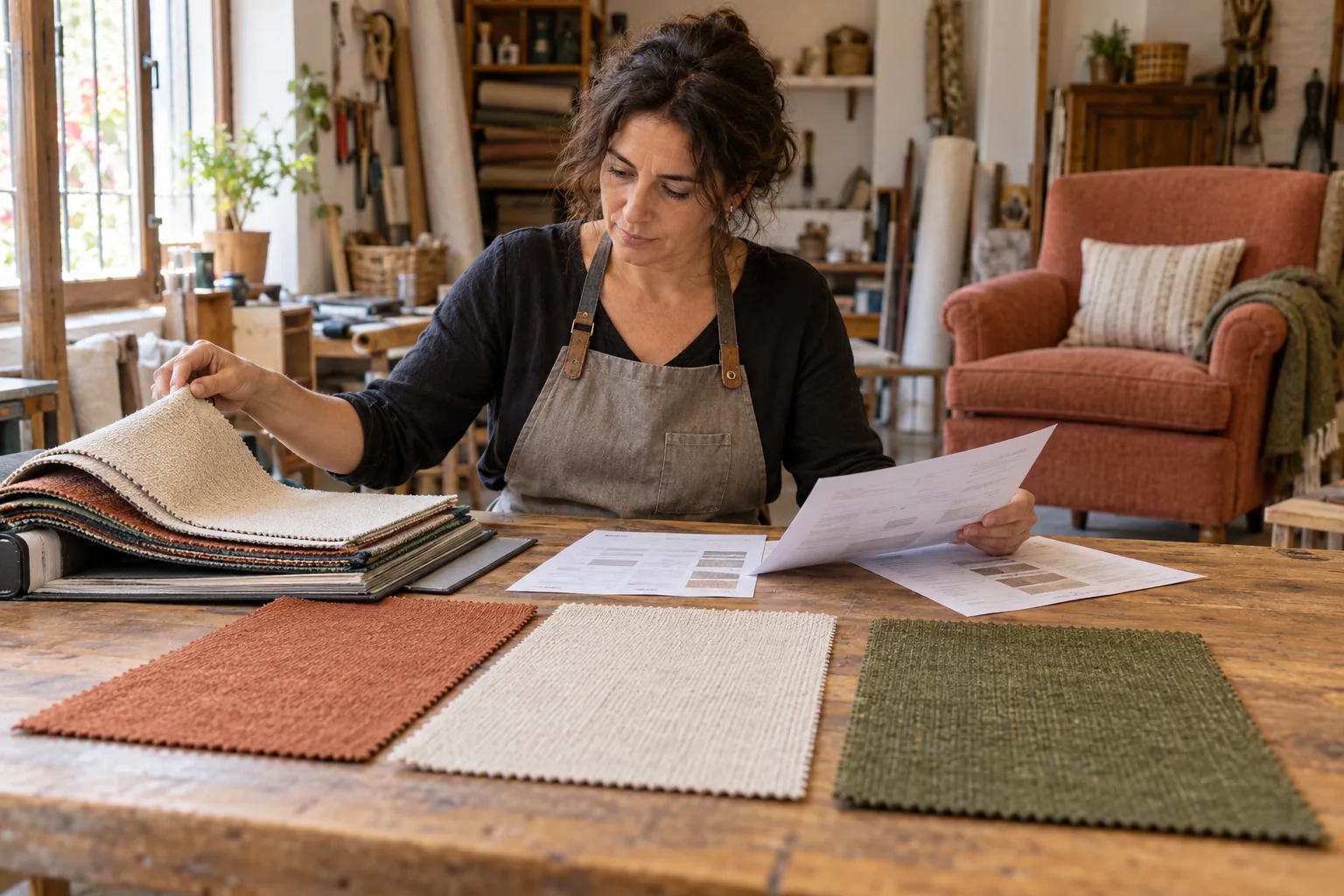
Two fabrics, one question the number cannot answer
In this fictional case, you are preparing to reupholster a sofa. One specification lists 60,000 Martindale cycles; another lists at least 40,000. The person enquiring wants a cover they can wash at home. Choosing the larger figure does not answer that question: the care information for each reference needs checking, along with whether the project supports the requested solution.
We propose trying a text assistant to prepare a fabric specification comparison: what each document says, what is missing and what to ask the supplier. You will find fictional inputs, a manually prepared reference table and an instruction to try. AI does not choose the fabric or replace the upholsterer’s assessment. This exercise reports no completed trial results.
Keep abrasion, pilling, colour and care separate
Kvadrat’s documentation explains that Martindale tests abrasion resistance. It describes pilling, the formation of small fibre balls on the surface, separately from lightfastness, which concerns retaining colour under light exposure. Do not turn an abrasion figure into an answer about another field.
M&V Textil’s guide also treats abrasion, pilling and colour transfer as factors to assess together with intended use. Our proposal therefore has no automatic “best fabric” score. An undocumented field stays open; it is neither a bad result nor a good one.
Prepare the trial with specifications identified by supplier, collection, reference, colour and date or version where provided. Keep each passage with its document and page. Record a missing date. Do not merge two specifications simply because their fabrics have similar names.
- Abrasion: retain the value, unit, sign and method as written. “At least 40,000” must not become “exactly 40,000”.
- Pilling and colour fastness: retain the scale or test for each result where given; do not transfer values between fields.
- Care: keep the wording for that reference and any document it refers to. A marketing phrase such as “easy clean” must not become permission to wash.
- Enquiry: record intended use, preferences and open questions. Fabric choice, quantities, pattern making and technical acceptance remain with the professional.
Exercise TP-01: neither document supports home washing
These specifications and the enquiry are entirely fictional and do not describe products from the cited suppliers. Enquiry E1: “A sofa at home beside a window. I would like to wash the cover at home.” A removable-cover solution has not been confirmed. Sheet A1, fictional supplier A, Ladera collection, reference LA-01, terracotta, version 1: “Abrasion: 60,000 Martindale cycles. Pilling: not stated. Care: consult appendix C.” The appendix is unavailable. Lightfastness is not stated.
Sheet B1, fictional supplier B, Ribera collection, reference RI-02, olive, version 1: “Abrasion: ≥40,000 Martindale cycles. Pilling: 4, scale 1–5. Care: do not wash; consult the supplier about professional cleaning.” Lightfastness is not stated. These are invented reading-test inputs, not cleaning instructions for real fabric.
Prepare your reference answer first. The following table was written by hand; it is not observed AI output. It does not support ranking the fabrics by lifespan or declaring either suitable for this sofa.
| Field | A1 · Ladera LA-01 | B1 · Ribera RI-02 |
|---|---|---|
| Declared abrasion | 60,000 Martindale cycles | ≥40,000 Martindale cycles; retain ≥ |
| Pilling | Not stated | 4 on a 1–5 scale; not an abrasion figure |
| Home washing | Unconfirmed: appendix C missing | Unsupported: B1 says do not wash |
| Light beside the window | No data; ask | No data; ask |
| Next enquiry | Request appendix C and lightfastness data | Clarify care and lightfastness data |
The instruction: trace the comparison back to each sheet
Copy this instruction and add E1, A1 and B1 in full: “Prepare an administrative draft comparing upholstery fabric specifications. For each statement show supplier, reference, version, section and supporting passage. Separate abrasion, pilling, lightfastness and care. Preserve signs, units and scales. If information is missing, write not stated or document pending. Do not fill gaps using general knowledge or another fabric. Do not rank references by quality or lifespan, recommend treatments, calculate quantities or accept a fabric for the enquiry. Separate E1’s preference from a documented property. Also return open questions for the supplier. Fictional data: [paste E1, A1 and B1].”
Save the first response and check it against TP-01 field by field. In particular, check whether it invents appendix C, permits washing B1, turns ≥ into equality or concludes that LA-01 will last longer. None of those conclusions belongs in the human reference. Check citations too: naming A1 does not establish that a statement comes from A1.
An assistant can produce a plausible summary containing mixed-up information. Anthropic’s documentation on incorrect answers recommends allowing uncertainty and checking support for statements; it does not establish that this exercise works in a workshop. Check every item against the original document; scanned sheets, misread symbols and split tables require checking the transcription before comparison.
When two documents disagree
Add a second fictional round: A2 retains supplier A, LA-01 and terracotta, but has no date and gives different care guidance. We do not know whether it supersedes A1. The reference answer should preserve both documents and flag the discrepancy for clarification; their pasted order does not establish which is current.
Before handling a real enquiry, request the supplier’s documentation applicable to that reference and clarify unresolved points. Do not infer behaviour around pets, stains, light or washing from a photograph or one test. Do not convert cycles into years of life or a guarantee for the finished sofa. Kvadrat’s documentation itself cautions that high abrasion results do not indicate product lifespan.
To prepare a customer explanation, start with a sentence grounded in the documents: “In this exercise, A1 does not confirm washing and B1 rules it out; the cover solution and lightfastness still need review.” On a real job, the professional adapts the explanation to confirmed documentation and their assessment of the furniture. No cleaning treatments or products are applied here.
A pilot that can also conclude it is not worthwhile
Try TP-01 and the A2 round using fictional data only. Then change a reference or remove a scale and write the expected answer again before consulting the assistant. Preserve input, first response, correction and full preparation and review time. Compare that time with preparing the same table yourself.
Count mixed references, altered signs or units, unsourced additions and unsupported care advice separately. Agree before the trial that any such error requires correction and another review of the comparison. Afterwards, decide whether to continue, change the format or keep a manual table. Assume no time savings or accuracy.
You need no customer data for this trial. Use invented documents and enquiries. Entering real commercial or personal information requires authorisation and suitable access, use and retention conditions; also check whether supplier specifications may be shared with your chosen tool.
From a manual table to custom integration
In the manual trial, you prepare the text and check the response. There is no catalogue connection, purchasing or workshop software update. Before commissioning development, check whether a table or your existing tool’s documentation solves the problem. Verial, for example, describes material records and links to external files in its upholstery management offering. That is the supplier’s description; we have verified neither its operation nor an Adaris connection.
If the trial justifies considering integration, an initial scope could read authorised specifications from an agreed folder, preserve versions and prepare comparisons awaiting review. Formats, permissions, table extraction, limits and error recovery would need checking. A responsible person would confirm each item before using it in a proposal. There would be no automatic fabric choice, technical acceptance or supplier ordering.
Adaris develops custom software, CRM and automation with AI case by case. This comparison workflow would be a proposal requiring assessment, scope and a quote, not an available proprietary upholstery tool. Commercial communication is in Spanish.
Related services
Sources
Are your fabric specifications spread across documents?
Tell us in Spanish how you receive specifications and who validates the material. With fictional documents, we can assess a scoped comparison or integration, with scope and quote to be agreed.