
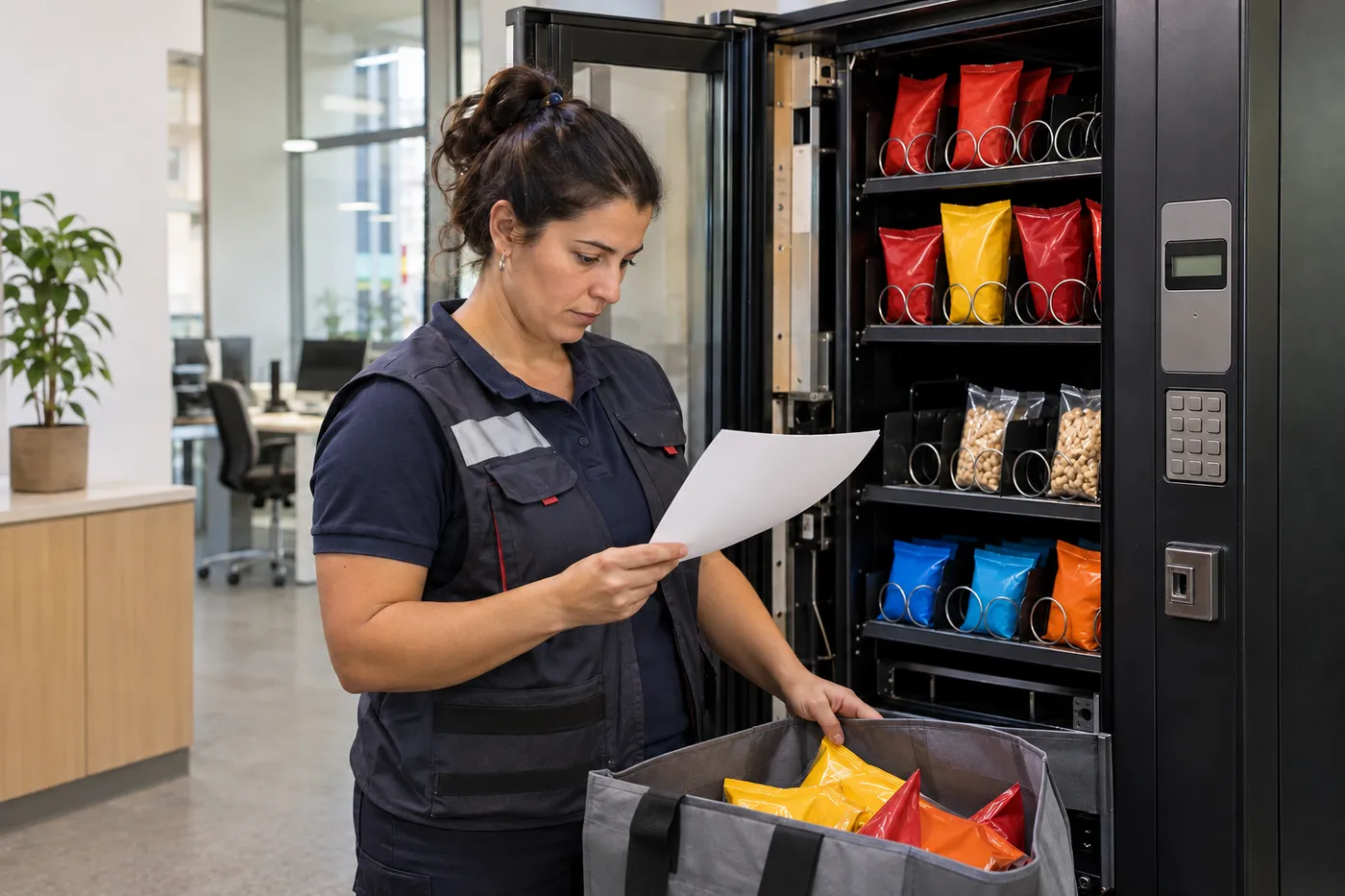
A prepared load is not yet a restock
Preparing ten packs for a machine does not establish that all ten reached its spirals. A vending route can keep the plan for each machine separate from goods leaving the warehouse, quantities actually loaded into the machine and goods returned in the van. If a visit does not happen or a quantity is unconfirmed, it remains pending rather than becoming actual stock.
Before commissioning software, examine your current tool. Repónlo describes load lists and restocking by slot; Verial describes recorded stock per machine and warehouse based on movements. Ask for a demonstration using your exceptions and check exports, permissions and costs: an existing product may fit without custom development.
Two machines and a last-minute change
In this fictional example a route carries twelve units of one product: eight are proposed for machine A and four for B. At A, the operator counts three units available and restocks five; the other three planned for A are recorded as not loaded there. At B, the premises cannot be accessed and the visit remains pending.
On return, the operator records seven units still in the vehicle: three not placed in A and four intended for B. The office reviews the difference between the plan and confirmed movements. B’s availability remains unchecked; the machine is not considered restocked merely because the goods were in the van.
Reconciling parts installed and left over in a van needs the same care: each movement needs context and confirmation, rather than an inference from the original list.
When seven units should return, but you count six
Continue the fictional case with an exception: on return, the operator counts six units in the van instead of the seven in the earlier journey. The twelve units loaded and the five confirmed as restocked remain recorded; this case has no other recorded vehicle movement. One unit remains unexplained. It is not a sale, loss or return that can be invented to close the route.
The office would review the count, supporting records and any missing movement with the route operator. The proposed record retains the seven expected units, the six counted, the time and author of each entry and a person responsible for resolving the difference. A correction keeps the earlier value and its reason; it does not erase the discrepancy or change another location just to balance the total.
Do not add the three units already in A to the van load: they belonged to another location. The five restocked units are not sales. A held eight immediately after that restock only if no other movements occurred between the count and the refill; that calculation does not establish availability on return. B remains unchecked. Reviewing quantities does not determine whether a product is fit for sale.
| Record | What is recorded | Resulting status |
|---|---|---|
| Van | 12 loaded and 5 restocked; no other movement recorded | 7 expected versus 6 counted: difference of 1 pending review |
| Machine A | 3 counted before and 5 restocked afterwards | 8 immediately after that refill, subject to the stated condition; not a later count |
| Machine B | Visit not completed | Restock and stock remain unconfirmed |
| Sales | The route provides no confirmed sale | Do not record the unexplained unit as a sale |
Information worth keeping
A record can hold the machine identifier and location, date and person attending, product and slot, proposed quantity, confirmed restock and observations. Keep the date of the last count and distinguish a counted figure from an estimate. If batches or dates are recorded, attach them to the product actually handled and leave them unconfirmed when information is missing.
Keep warehouse, vehicle and machine as separate locations with reviewable movements and traceable corrections. A cancelled visit, substituted product or return needs its own status. As when syncing stock between a physical shop and an online store, agree which system owns each field and how discrepancies are resolved.
Where automation helps and where it stops
A rule could prepare a load from the latest recorded quantities and planned visits, showing the date of each input. Without a recent count, it should present the quantity as an estimate for the responsible person to review. It cannot turn an assumed sale into a confirmed one or guarantee availability or product conditions.
For free-text notes, generative AI could propose a summary linked to the original notes and flag uncertainty; a person would check machine, product and quantities before saving movements. An assistant with restricted read permissions could consult authorised records through application functions: OpenAI documents that general possibility. Writing or correcting records would need controls and explicit authorisation. This is a proposal to assess, not an existing Adaris integration.
Do not put real customer data into AI services without permission and suitable conditions. The operator physically checks dates, products and condition under their own procedure; the draft does not replace that check or make food safety decisions.
Configure, connect or build
Ask the provider to show what happens when a visit is incomplete, a product is substituted or a count conflicts with a record. iVending describes consulting dates of the last load; do not assume every system handles exceptions alike. Request a demonstration with fictional data and check licence, support, data export and offline use if needed.
If useful software already exists but route and warehouse records remain separate, Adaris can assess integration against the actual permissions, exports or interfaces available. If the workflow does not fit, custom software may be considered. Agree each data source, permissions, confirmations and error handling first; compatibility with any particular machine or program must be checked.
A bounded pilot and a simple next step
A first engagement to scope with Adaris could be a route-closing record that brings together the van load, confirmed restocks, return count and differences with an assigned owner. We would first check whether your current system can be configured for it; any connection or development depends on the available interfaces and permissions. A joint trial would cover both seven returned units and a count of six: the difference must remain open without becoming a sale or changing machine records. Access rights, correction history and the agreed export would also be checked. The pilot could track unresolved differences, corrections and review time over an agreed period, without promising improvements.
To discuss your case with Adaris, describe how you prepare routes, which tools you use and where information gets lost. Scope, access and validation can be agreed afterwards; you do not need to prepare a pilot before contacting us.
Related services
Sources
What actually happened to your route load?
At Adaris, we are your expert team for integrating AI into vending-route preparation, comparing the van load with confirmed restocks and returns without treating a load as machine stock. Tell us how you prepare restocks and what you need to confirm on return. We work remotely in Spanish across Spain.