
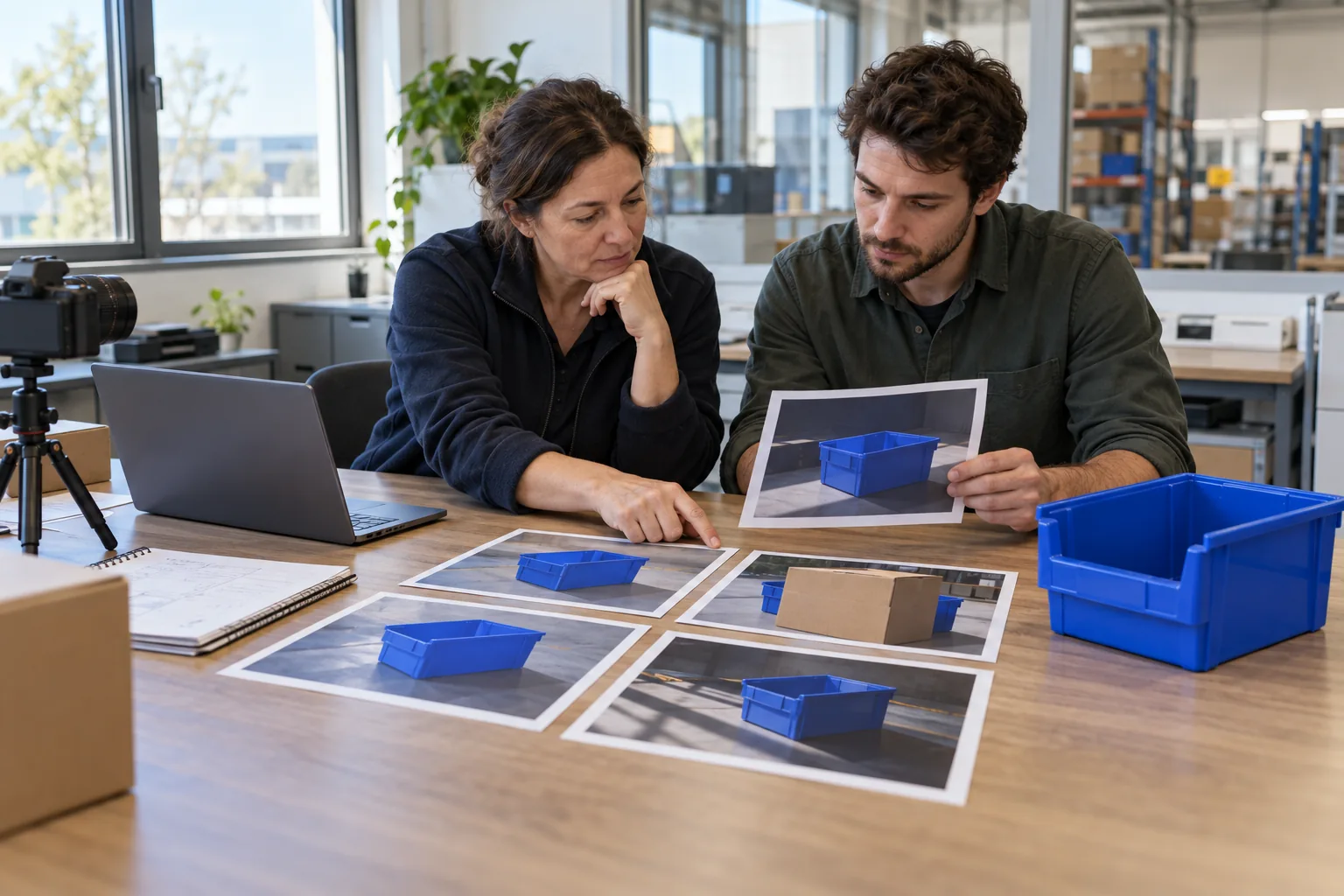
A thousand frames are not a thousand different situations
A long video of the same box can fill a folder without answering the pilot question: what happens with a different box, different light or partial obstruction? Before training with Adaris Vision Studio, prepare a map of conditions, an annotation rule and separate material for checking the outcome. This guide offers no universal photo count or promised accuracy.
You get a fictional input sheet for detecting plastic bins at a preparation station, a proposed allocation of material and a next-step decision. This is an evaluation plan, not a completed installation or a guarantee that your cameras can support the task.
What Studio provides and what your project needs to agree
Studio is the preparation environment: it lets you import images and videos, generate annotation proposals, review them, create dataset versions, train and evaluate a detector. Player runs the prepared package with the sources and options selected for delivery. The public Adaris tour shows this separation.
Automatic proposals need human review. The current Studio technical catalogue describes immutable versions: editing the working material does not change an existing version. It also describes evaluation with false positives, false negatives and per-class metrics. These help examine a trial; they do not establish that a model suits a particular line. Confirm the equipment, sources, scope and trial conditions with Adaris before relying on an installation.
A text assistant used manually might help organise a fictional input sheet; reading a description does not train the detector or check the video. Connecting an automation also requires specifying who receives the output, which actions are allowed and who supervises. Compatibility with the customer system needs its own assessment.
The input sheet to agree before sending images
Entirely fictional case: a business wants to locate blue plastic bins on a table. It is not asking to identify their contents, read labels or decide whether an order is complete. The process owner retains responsibility for accepting the work. This keeps object detection from becoming a promise of complete quality control.
| Field | Proposed example | Decision still needed |
|---|---|---|
| Objective | Mark each visible blue bin on the table. | Agree what counts as a visible object. |
| Class | blue_bin: a rigid blue container of the illustrated type. | Review examples and counterexamples with the owner. |
| Out of scope | Contents, damage, codes and other bin types. | Do not infer these properties from a detection. |
| Proposed source | Authorised images from the station being assessed. | Check capture and quality; assume no compatibility. |
| Initial use | Supervised comparison with human annotations. | No machine commands or automatic order acceptance. |
List conditions as well as files
Use this matrix as a proposed capture checklist. The groups are invented; they are not collected samples or results. Record the session, source, conditions and annotation reviewer for each group. If the material does not represent a condition, mark it as unevaluated instead of assuming coverage.
| Group | Situation to represent | What to review |
|---|---|---|
| A · development | Separate, fully visible bins under usual lighting. | Each visible bin has the agreed annotation. |
| B · development | Nearby bins partly covered by cardboard. | How much visible evidence supports an annotation. |
| C · development | A table without blue bins and with similar objects. | No nonexistent bins are added. |
| D · reserved check | A separate session with different units and agreed conditions. | Keep it apart from material used for training and tuning. |
| E · boundary to assess | Lighting or position changes with no samples yet. | Collect authorised material or exclude the condition from the pilot. |
Reserve a check beyond another slice of the same scene
Ultralytics explains in its training documentation that near-identical frames can contaminate training and validation splits. It recommends splitting by the unit that will be new, such as a session or video, and keeping a final test apart from tuning decisions. This is a methodological principle, not a product accuracy comparison.
The Studio functional document describes grouping by source when there are multiple independent sources, and a temporal split for a single video source. That mechanism does not establish that different files represent independent scenes. Supply their real provenance: renaming or trimming the same video does not create a new session.
For this pilot, we propose holding group D outside development material and agreeing how its check will run. Training teaches the model; validation guides adjustments; the reserved check answers the agreed final question. We do not present that third set as an automatic Studio feature. If it is used to improve the model, obtain a fresh reserve for the next check.
A partly hidden bin needs a rule before training
In the example, cardboard hides most of a bin. One person thinks its edge is visible; another cannot distinguish it. Do not settle the disagreement by simply accepting the automatic proposal. Preserve the case, ask the process owner for a criterion and review affected examples before freezing a version.
Agree with Adaris how to handle partly visible objects and what to do when evidence does not support an annotation. Do not extrapolate hidden dimensions or treat a detector score as a physical measurement. If the process needs to know what is inside an opaque bin, its external image and this detection class do not answer that need.
Studio documentation requires annotation review before creating the training version. Reviewing data and accepting a technical solution are separate decisions, each requiring an owner.
A measurable pilot without invented results
First propose a review of the material and capture feasibility. Then agree in writing on classes, included conditions, reserved material, owner and acceptance criteria. We prescribe no minimum image count, price or accuracy threshold for every business.
In the supervised check, record reference bins missing from the output and detections that do not match a reference bin, broken down by condition. Also record ambiguous cases, capture failures and review time using an agreed procedure. These are proposed pilot fields, not measured results or a list of included automatic features.
The next decision may be to continue, collect a missing condition or reconsider capture. A missing class or relevant condition cannot pass on the strength of an overall average. Link observations to the dataset version and model evaluated so you can explain what changed.
What to send Adaris and when to request integration
For the first enquiry, describe the object, the decision to support, the proposed source, difficult conditions and reviewer. Use fictional data when practising the sheet. Before sharing real images, agree permissions, processing terms and a suitable channel; do not attach faces, number plates or commercial information by default.
Request a pilot with sample review and an agreed scope. If you later need to feed an application, trigger notifications or act on an installation, propose a separate integration and acceptance phase. We assume no connectors, hardware compatibility or existing production deployment.
You can compare how suppliers organise preparation and evaluation: MVTec presents Deep Learning Tool for labelling, training and evaluating industrial models. This description does not imply model interchange with Studio. Our practical proposal is to reach the Adaris conversation with an input sheet, condition map and reserved check. Commercial contact is in Spanish.
Related services
Sources
What samples does your pilot need?
Tell us which object you need to detect, which decision it supports and which conditions are missing. We will agree sample review and scope; commercial contact is in Spanish.