
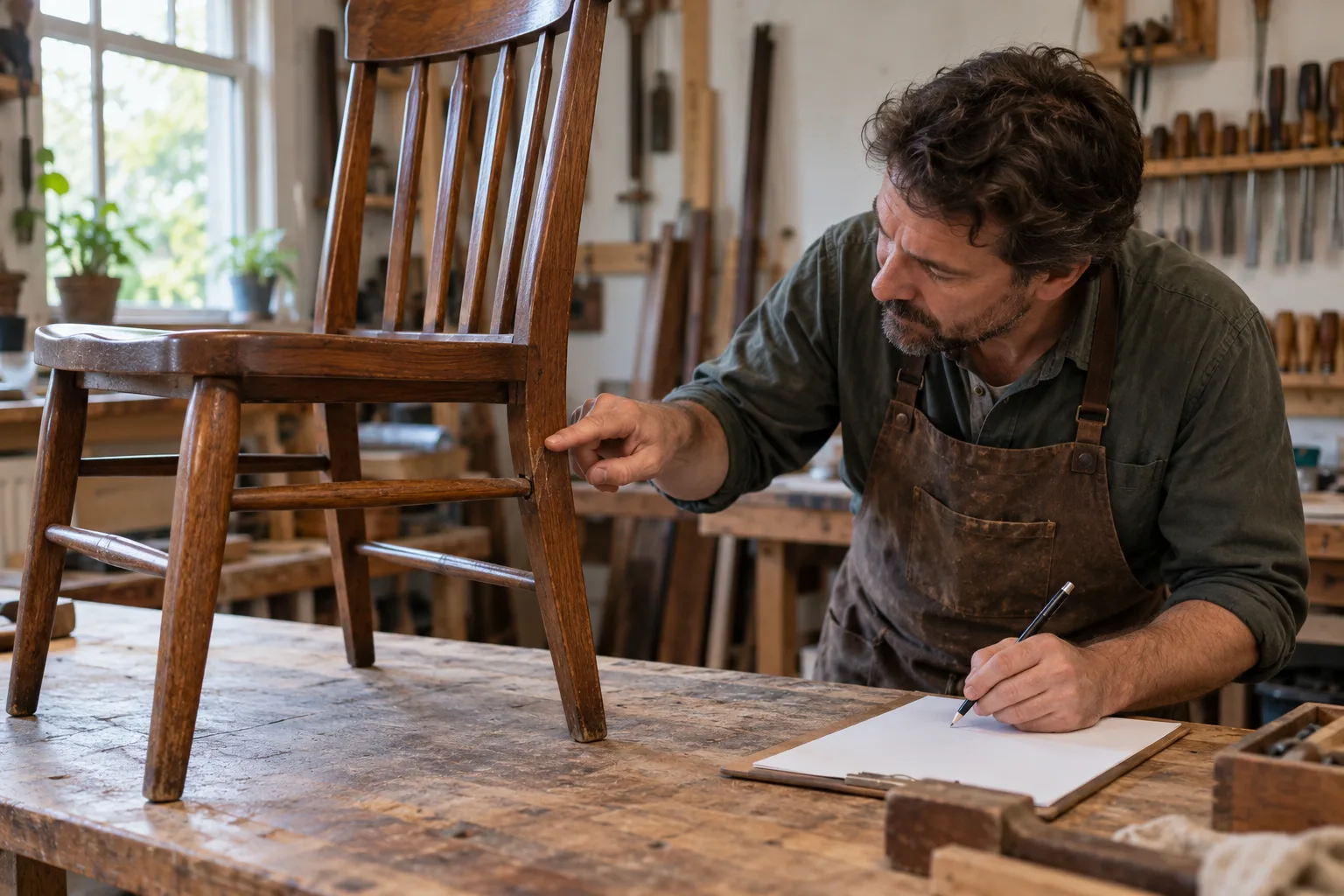
One leg and two photos may point to different joints
A customer says “the leg moves” and sends two photos. One shows where it meets the seat frame; the other shows the lower stretcher. Before preparing an assessment, keep those references separate: neither the word “leg” nor a photo establishes that every joint has been inspected. An AI-assisted record can organise what is known and the missing questions, but it cannot identify the cause or authorise use of the chair.
The Encolar Sillas workshop says it accepts photos for quotes; Canadian Woodworking recommends identifying parts when working on a chair. These are useful references for organising the case, not guarantees that an image is enough to decide on a repair. If instability is suspected, avoid sitting on the chair until a professional assesses it.
Fictional case: two views, an unconfirmed location
Chair S1. Note C1 from the imagined customer: “The back leg moves when I move the chair; I want to know what repair it needs.” Photo F1, according to its label: the joint between the right rear leg and the seat frame. Photo F2, according to its label: the joint between the side stretcher and the same leg. Note C2: “I do not know whether the movement comes from above or below.” There is no real inspection, and the cover image does not depict this job.
A hand-prepared reference would distinguish S1/F1, upper joint identified by the customer, movement not located; and S1/F2, lower joint identified by the customer, movement not located. Open questions: which viewing direction defines right? Is it the same chair in both photos? Has it been repaired before? Do not write “upper joint unglued” or “chair repairable with glue” as established facts.
A workshop record of open questions
Adaris can assess a case record gathering enquiries, authorised photos, viewpoints, areas and each decision’s status. Rules can flag missing fields; AI could help organise notes and questions for review without diagnosing the cause or declaring the chair safe. The professional decides what to inspect and agree.
For a pilot, prepare an S1 record manually from the fictional notes and compare it with the reference above. If the system is developed, the workshop would review its proposal in the same way: F1 and F2 are separately labelled joints, but the source of movement remains unknown. Agree permissions and access before using real information.
Before turning the record into a job
Use the record as a list of questions for assessment, not as a repair order.
- Identify each chair and describe orientation consistently: for example, left and right from an agreed viewpoint. If the viewpoint is unclear, leave it open.
- Associate each photo with a joint and distinguish the customer’s account from workshop observations. A labelled photo alone does not prove that the joint shown is moving.
- The professional decides what inspection is needed, whether other joints are affected and how to assess the intervention. Do not force parts or recommend adhesives based on AI text.
- Explain what remains to be inspected and agree the scope before work; if new findings arise, review the agreement with the customer.
A small trial and a possible next step
Compare three invented cases with a manual reference: S1; another with two unoriented photos; and one with a previous repair but no identified product. Count mixed-up joints, omitted uncertainties and invented diagnoses; compare preparation and review time with the manual process. These are proposed measures, not observed results.
If records must be connected to photographs, quotes and permissions, a custom integration could be assessed: specify who may read each item, who may edit the record and who approves a change. An agent or automatic connection is not needed to start, and compatibility with workshop software is not assumed. Before sharing real data or images, check permissions, confidentiality and provider terms. We can discuss the scope; please contact us in Spanish.
Related services
Sources
Want to organise repair records?
Adaris, an AI-vision integration specialist for chair repair, can organise photos and flag possible views of a joint while leaving definitive identification to the repairer. Describe your process without private data to discuss a custom integration. Please contact us in Spanish.