
A loaded case does not confirm each piece
If a case is on the truck but no one has checked its contents, record the case as loaded and the pieces as awaiting verification. An AI-generated list can organise notes; it cannot see inside or turn a plan into a fact.
Before the handover, the responsible team checks each piece against the inventory and records what was observed, what remains to be checked and who will review the question. Packing, loading and assembly safety remain the responsibility of professionals and the applicable plans.
Keep pieces, cases and status separate
Touring involves assembly, dismantling and packing documentation. A Spanish Ministry of Culture props questionnaire considers these plans and their adaptation to the venue; the New South Wales Arts Unit discusses planning the transport of scenic elements. Neither authorises assembly from a summary.
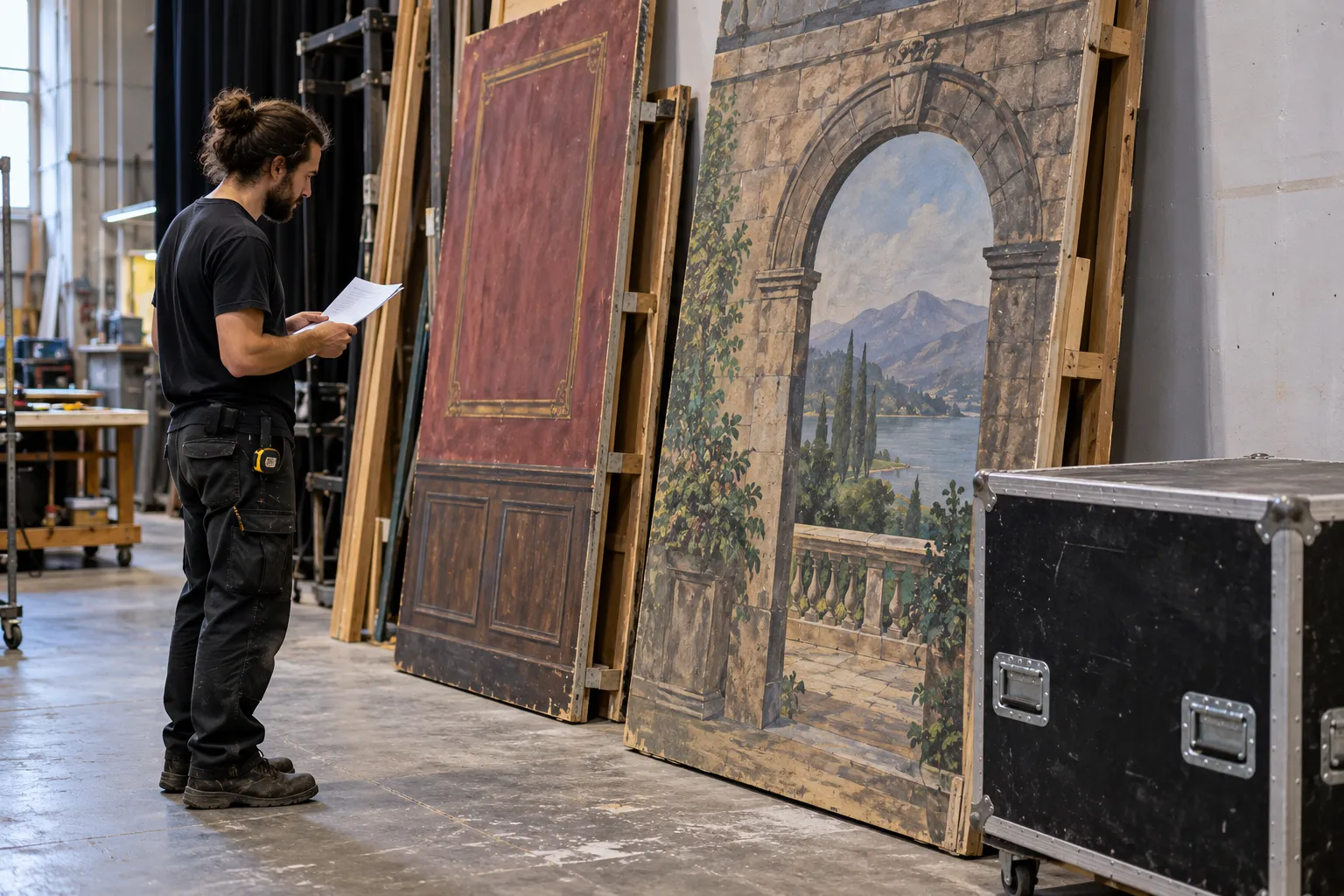
A painted flat, its case and its location are separate records. Keep the piece ID, description, planned case and verification status. Do not assume similar names refer to the same flat or that a closed case contains everything planned.
Fictional case: two flats and one case
In an invented show inventory, flat A has a painted window and flat B a painted door. The plan assigns both to case C. Closing note: “Case C loaded. Flat A checked inside before closing. Flat B was seen beside the case; no one recorded whether it went in.”
A useful result retains A as checked and B as pending, with C as its planned case. Loaded describes the case, not whether B is inside. The responsible person should locate B and record the check before changing its status; do not declare it lost or open or move the load without following the team’s procedure.
A touring record that preserves uncertainty
Adaris could assess a custom register linking each piece to its planned case, authorised observations and verification status. An AI function could suggest discrepancies and handover questions, citing the original note; a person would check each proposal before updating or sharing the record.
In the fictional case, the register would distinguish loaded case C, flat A checked inside and flat B pending: seeing it next to the case does not prove it went inside. The tool cannot inspect the interior or declare a piece missing or lost by inference.
Before connecting tools, the team would agree permissions, sources, retention and review procedures. The proposed system does not replace a physical count or authorise handling, loading or assembly.
Run a small pilot against a reference list
Create a reference record reviewed by the team and test three fictional variants: a loaded case without an interior check, a piece confirmed in another case, and two similarly named flats. Count omitted details, confused pieces and invented checks; record human corrections. These are proposed measures, not measured outcomes.
The list helps prepare questions and a handover; it cannot replace a physical count, current plans, venue review or safety decisions. Our sound cue sheet guide addresses a different technical handover: cues and timing.
From a manual record to a considered integration
For a small tour, a reviewed record may be enough. If several people need to consult changes, a restricted register with history per piece and case could be considered. An agent might propose discrepancies from authorised data without updating or sending the register before human approval.
First check available tools and permissions and what information can be shared. Adaris assesses custom software and integrations case by case; this example does not describe an existing application or a guaranteed connection.
Related services
Sources
Are checks getting lost between cases and pieces?
At Adaris, we are specialists in AI integration for touring scenery; we can link pieces, cases, destination and stated status, leaving physical counts and load checks to the company. Tell us how you coordinate your tour. We can assess a custom register with permissions and human review. Commercial support is in Spanish.